Practise without occupying production equipment
Provide opportunities to explore equipment and rehearse selected interactions in virtual reality (VR). A virtual training activity could reduce the need to reserve a working machine for every practice session.
Potential benefits
- Reduce competition between training and production for machine access.
- Allow selected tasks to be repeated away from operating equipment.
- Reduce the machine and instructor time needed for suitable practice activities.
Relevant challenges
Training and Onboarding
- Training can cause machine downtime
- Expensive equipment is not always available for training
How the approach works
The relevant equipment and task interactions are represented virtually. Learners can repeat selected activities away from the production machine, with feedback designed around the procedure and learning objectives.
Research and demonstrations
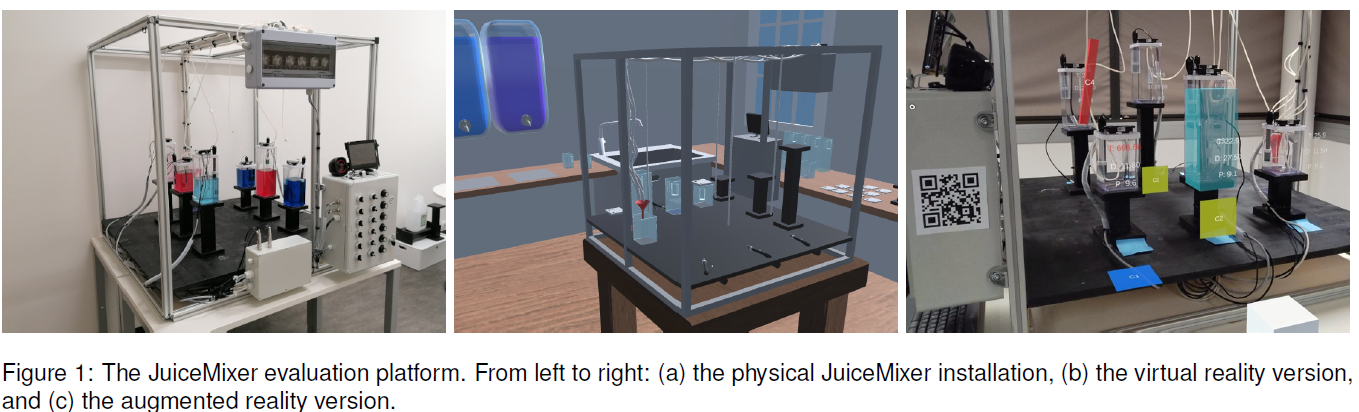
The virtual JuiceMixer example shows equipment interaction in a digital representation. A training activity would build on that foundation with the target procedure, guidance and feedback.
Adapting it to your workflow
A project would prepare the equipment model and define which actions can be represented meaningfully in VR. Learning outcomes would be checked against practical performance rather than assuming that virtual completion proves readiness.
What a project could evaluate
A pilot could measure demand for machine access and instructor time alongside learning outcomes, repeat practice and transfer to the physical task.