Eye tracking for attention analysis
Investigate where people look and how visual information relates to their responses. A study could compare interface designs under defined viewing conditions, using gaze alongside accuracy and task performance.
 EIRS
All demos · Industrial challenges
Explore how visual cues, scene complexity and fatigue affect distance judgement in virtual reality (VR). Controlled experiments, including a 27-hour sleep deprivation study, combine custom software and precise performance measures to investigate human perception.
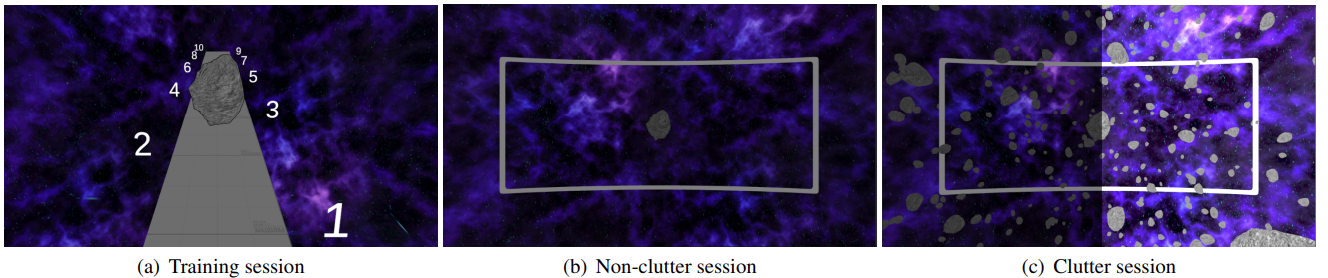
People use visual information to judge distance and position when navigating, inspecting equipment or operating systems remotely. A cue that helps in one virtual scene may behave differently as the scene becomes cluttered or fatigue increases. Controlled experiments help distinguish these effects and explain which design choices support accurate judgements and reliable responses.
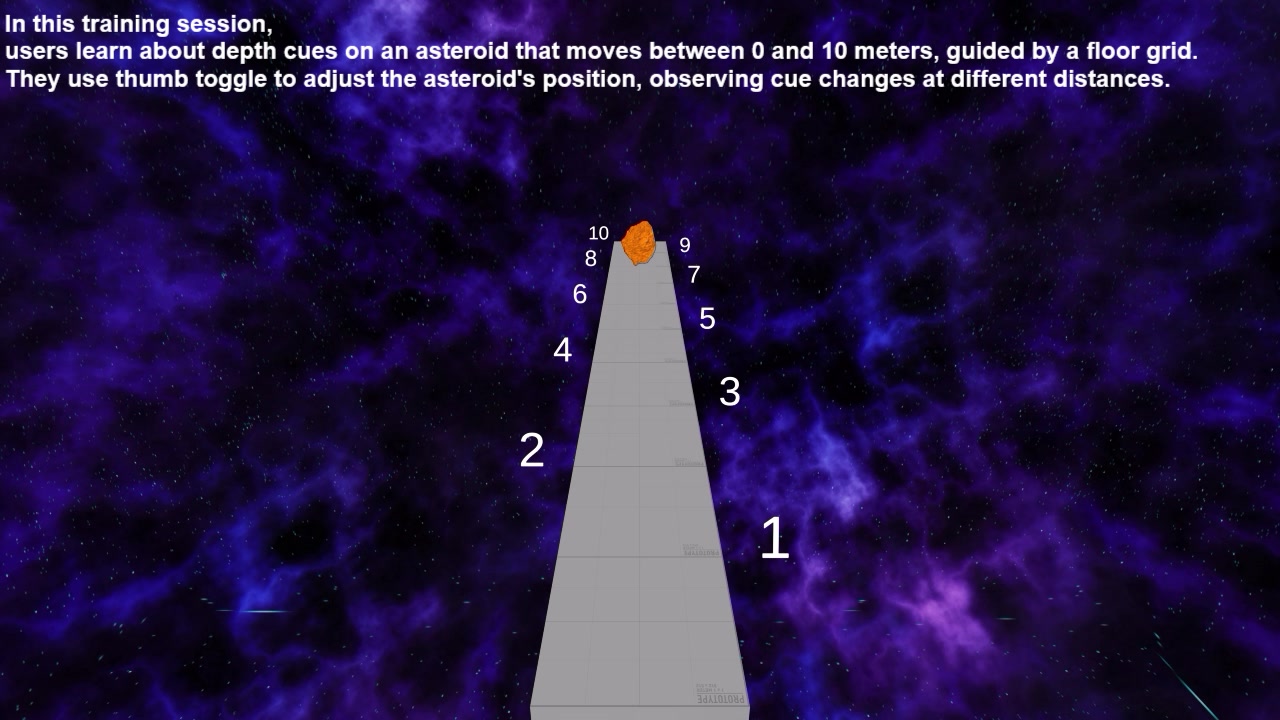
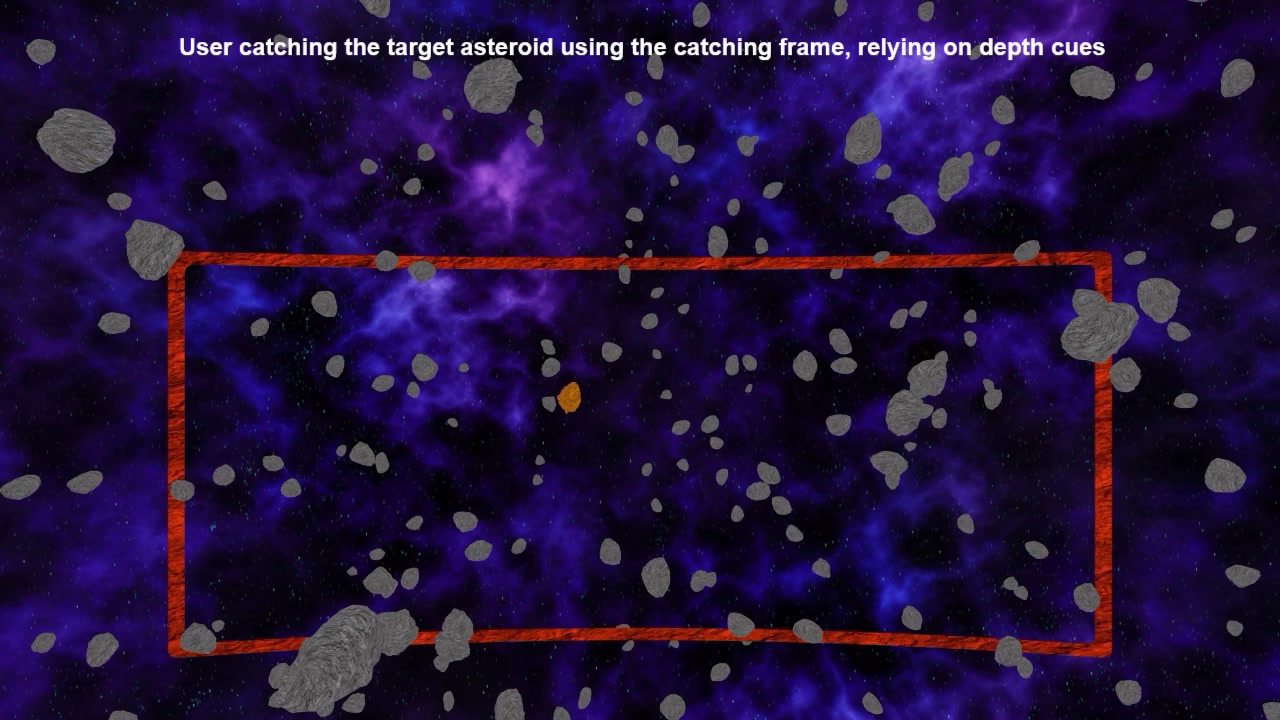
A repeatable VR task asks participants to judge the distance of a moving target against a reference frame. The system can vary the visual cue and scene conditions while recording responses.
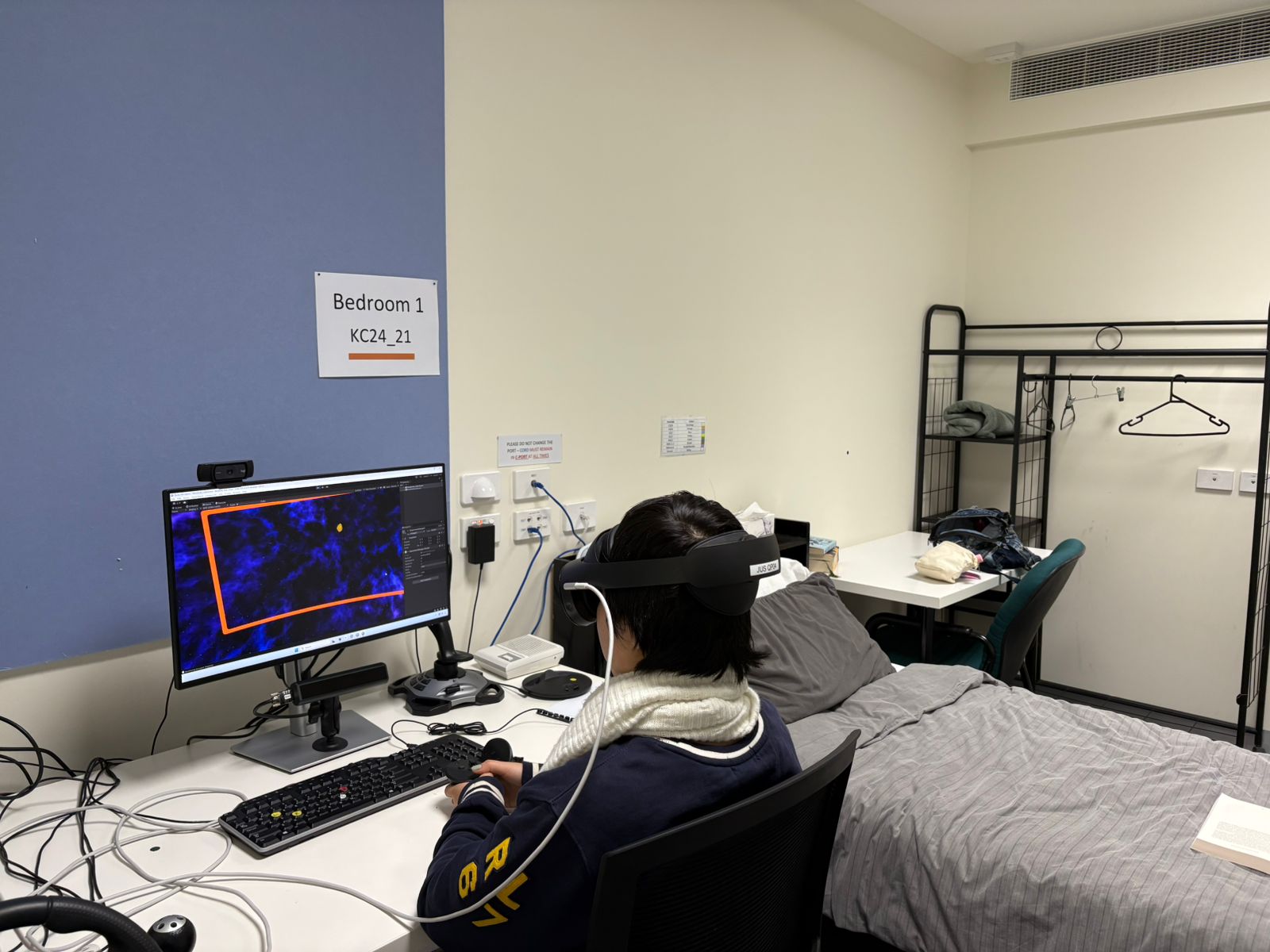
The task was built in Unity 2021.3.15f1 and run on Meta Quest Pro via Oculus Link. Both studies used this shared setup, allowing the research to examine different conditions with a consistent task.
Numeric text presents distance directly. Colour provides a near-to-far scale, while texture blur offers a subtler depth cue. The first study compares these cues in clear and cluttered scenes. The second repeats the task as wakefulness continues, allowing researchers to examine how cue performance changes with fatigue.
Participants stayed awake for 27 hours and completed six testing sessions from evening through the following morning at the University of South Australia (UniSA) Sleep and Chronobiology Laboratory. The protocol was continuously monitored and kept the VR task consistent as fatigue increased. It required careful scheduling, repeatable conditions and a study design that could preserve measurement quality across the night.
Distance error showed how close each judgement was, while response probability showed whether participants responded at all. The first study also assessed visual attention. The fatigue study tracked participants’ sleepiness, mental effort and VR discomfort. Considering these measures separately helps reveal trade-offs that a single performance score could hide.
In the first study, added cues improved distance judgements in clear and cluttered scenes. Numeric text and colour generally gave stronger accuracy than subtle blur. In the fatigue study, accuracy and response likelihood changed as wakefulness continued. Text cues supported more accurate responses, while colour and blur maintained a higher likelihood of responding at peak fatigue. This shows why cue designs need to be tested against the task and conditions where they will be used.
Questions about how people perceive, decide or perform can be translated into controlled studies. A project can define the task and conditions, build a repeatable virtual or physical setup, select performance measures and participant feedback, and run the study under conditions relevant to the intended use. The findings can inform interface, equipment and workflow decisions before wider deployment.
Future studies could apply these methods to representative work tasks and environments, include different user groups, and combine performance data with workload measures and interviews. Where the research question supports it, they could also test whether cue presentation should adapt to task demands or validated measures of alertness.
Visual interfaces depend on how people judge distance, interpret cues and maintain attention. Controlled research can help teams investigate these foundations before relying on a design in training, inspection or remote operation.
Investigate where people look and how visual information relates to their responses. A study could compare interface designs under defined viewing conditions, using gaze alongside accuracy and task performance.
Examine how fatigue or changing performance affects interaction with a system. This can provide evidence for future adaptive support, with any state estimation or intervention requiring its own development and evaluation.
A collaboration could develop custom experimental software, measurement methods and a controlled protocol for a specific question about perception or human performance. The study design would reflect the precision and testing conditions the question requires.
Explore research and collaboration →VR depth-judgement task from the first study.
This work is part of DDIA, Data Driven Immersive Analytics in Digital Industries.
DDIA is an FFG COMET Module (2022 - 2026) at Know Center Research GmbH.