Immersive robot teleoperation
Guide a mobile robot while viewing its cameras through an immersive interface. This approach connects remote movement, viewpoint control and spatial context for an operator working away from the site.
Potential benefits
- Enable selected robot operations from a location away from the site.
- Reduce the need for people to enter difficult locations for suitable tasks.
- Give operators camera views and controls designed around the inspection activity.
Relevant challenges
Remote Support and Collaboration
- Remote users may have limited ability to interact with or inspect the physical environment
Inspection and Monitoring
- Inspections can require people to enter dangerous or hard-to-access environments
How the approach works
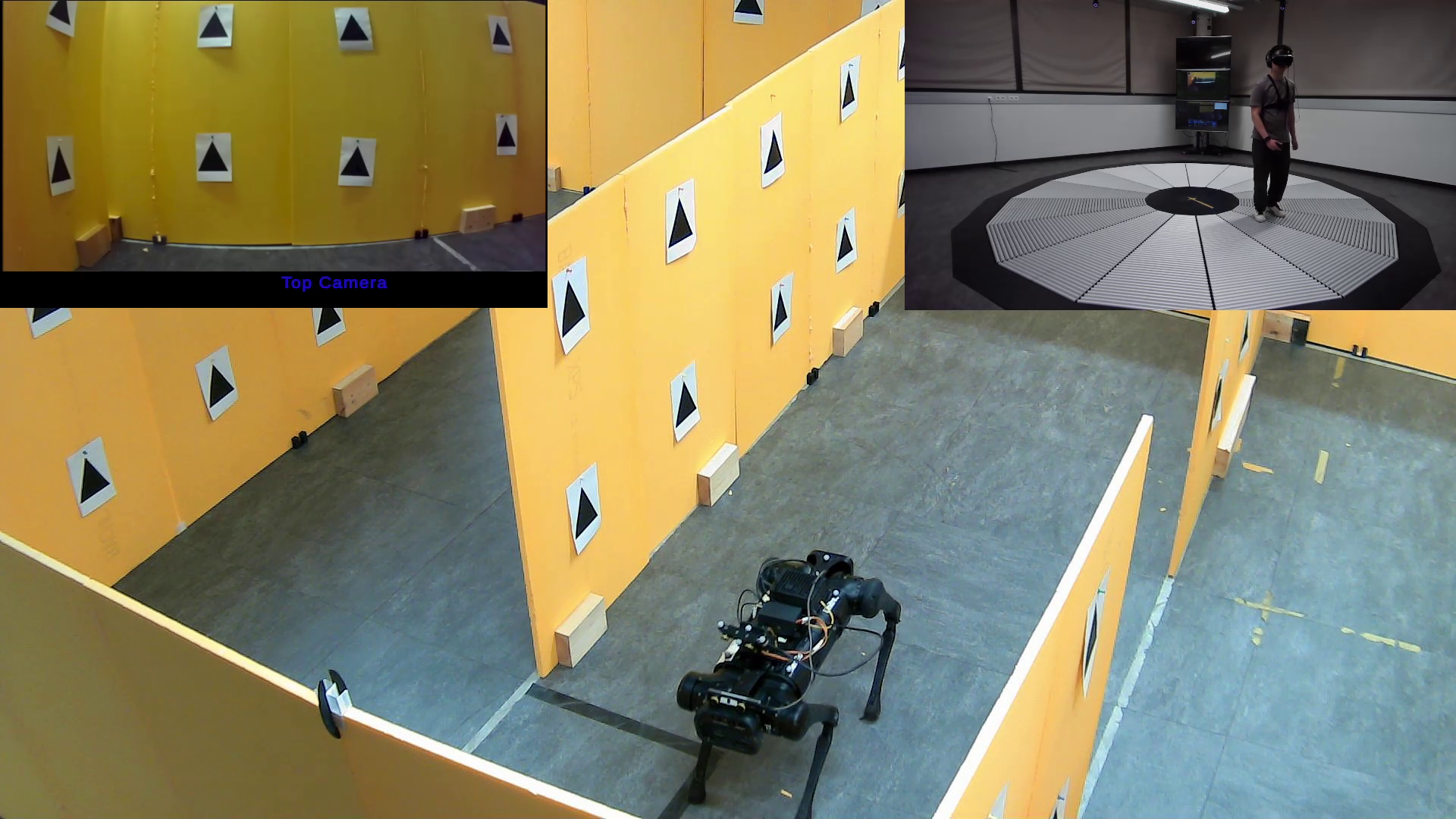
Robot cameras and communication interfaces are connected to a virtual reality (VR) application. Movement and viewpoint controls are selected around the robot and task, giving the operator a way to guide the robot and inspect what it can see.
Research and demonstrations
The telepresence testbed connects a quadruped robot to a VR operator interface and compares movement and camera-control methods. The inspection framework also connects navigation with recorded observations and specialist review.
Adapting it to your workflow
A project would integrate the target robot, cameras, network and site workflow. Control behaviour, operating requirements and failure handling would be evaluated with the intended environment and operators.
What a project could evaluate
A project could examine navigation and inspection performance, communication reliability, response timing and the operator’s understanding of the remote situation. A pilot could also assess which parts of the task can be completed without an operator being physically present.